
Repeatable Press · Bespoke Singularity · Directed by Byron Jupiter · Rendered with AI
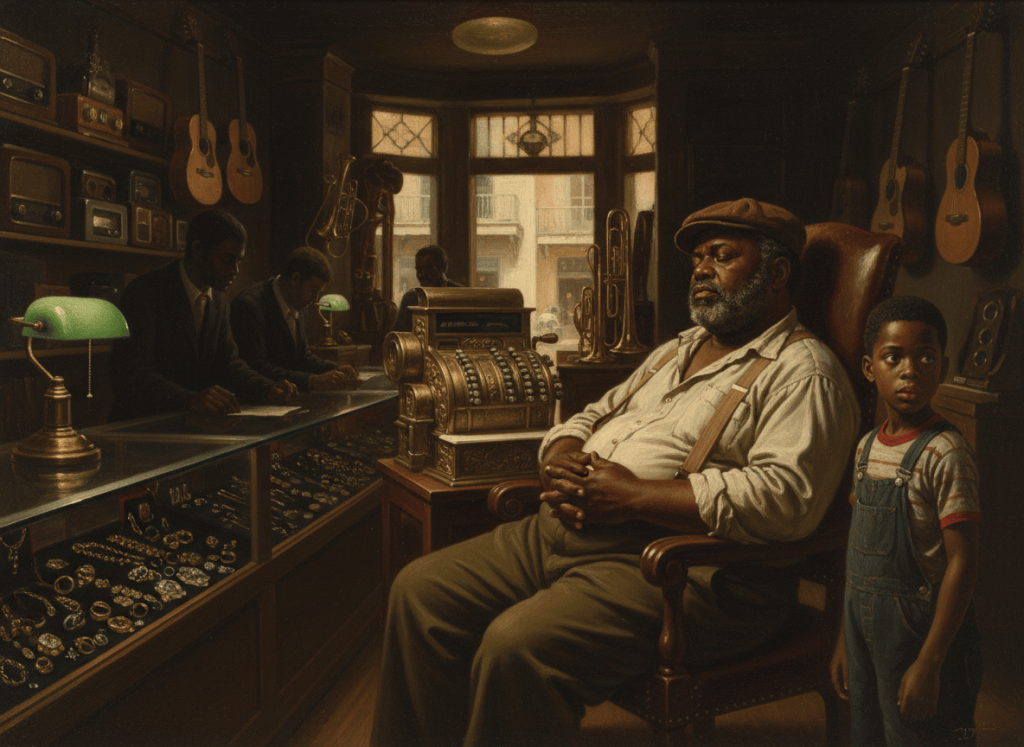
Creative license: an artistic interpretation of the author’s memories, not a photograph or likeness of the people described.
Profile

By Byron Jupiter
Before the console, before the catalog, before ten thousand session hours and a hundred and fifty collaborators and three names no filing system could reconcile, there was a boy from Claiborne Avenue, where his family ran a full-service Exxon, keeping watch at the back of Dave Gerber’s pawn shop on South Rampart Street while his Uncle Wilbert slept by the register. He was learning that every transaction is a relationship, and every relationship is a trust.
That is day zero. Not the first session, not the first credit, but the moment a child understood that the world runs on the connections between people, and that those who grasp this are the ones who build things that last.
The Station and the Pawn Shop
Byron Jupiter did not begin in a studio. He began in a family business. The Jupiter family owned and operated a full-service Exxon on Claiborne Avenue, and full service meant every driver was met face to face. The family name stood behind every fill-up and every handshake at the pump.
His second classroom was Dave Gerber’s pawn shop on South Rampart Street. The Gerber family worked the counter. In the back of the store, by the cash register, sat his Uncle Wilbert: a large man, the shop’s lookout, who mostly slept. Byron was his stand-in. While his uncle dozed, the boy kept the watch, and together they made the runs to the bank. The subject was not music but human nature. A pawn shop is a crossroads. Everyone passes through: the desperate and the hopeful, the hustlers and the elders, the children who will grow up to be somebody. From his post by the register, the boy learned to read all of them: when to trust, when to hold firm, and when to let something go. He learned that the object on the counter is never only an object. It is a story, a sacrifice, a bet on tomorrow.
He learned what lasts, too. Watching gold and diamonds cross that counter, he came to understand value: what holds its worth, why you save, and how patience lets value appreciate.
That instinct, to see the person behind the transaction, underlies everything that followed. It is why, four decades on, the people who enter Byron’s orbit do not simply get a session. They get seen.
You cannot engineer trust into a room. You bring it or you don’t. Byron brought it from the first day, because he learned it before he ever touched a fader.
Broader Than the Boards
The industry likes to reduce a producer to a single dimension: the sound, the credits, the records. But Byron Jupiter was never only a man behind the boards. The boards are one room in a much larger house.
He is an archivist. Long before anyone else thought to save the records, the session tapes, the photographs, and the stories of the people who built New Orleans music, Byron was keeping them. Not for ego, and not for a museum retrospective that may never come, but because he understood that a culture that does not archive itself will be archived by someone else, or not at all. The living archive at Jupiter Music House is not a vanity project. It is an act of preservation against an industry that discards its architects the moment a record stops selling.
He is a civic figure. The Solid Color initiative, a movement to bring resources, recognition, and infrastructure to the neighborhoods that produced the sound, is not a side project. It is the main work. The boards were the trade; the community is the purpose. No one spends forty years in a city’s studios without learning that the sound and the street are the same thing. When the neighborhood thrives, the music thrives. When the neighborhood is erased, the music becomes a ghost in someone else’s profit.
He is a mentor, not in the programmatic sense of a nonprofit with a mission statement and a brochure, but in the sense that matters. The kid who arrives at the studio door with nothing but hunger and a work ethic gets shown the console. Gets taught the codes. Gets told that asking for credit is not vanity; it is demanding what the system owes. Byron has been building the next generation of New Orleans producers and engineers quietly and stubbornly, one handshake at a time, because no one built that infrastructure for him, and he refuses to let the cycle repeat.
He is a businessman. Jupiter Music House is more than a studio. It is an institution: the place where the work happens, where the archive lives, where the community gathers, and where the next thing is being built right now. Its address, 7367 Chef Menteur Highway, is not a footnote. It is a headquarters.
The Three Names
The catalog is filed under three names: Byron Jupiter, Byron Jupiter Jr., and Big Fingers. The industry’s systems never decided which box he belonged in. That is not a clerical error. It is a metaphor.
Byron Jupiter has never fit a single box. Producer, engineer, archivist, mentor, civic leader, businessman, preservationist: he is all of them at once. The industry’s failure to file him under one name is the same failure that has left him, and people like him, uncredited and uncompensated for four decades.
Yet what cannot be categorized cannot be contained. You cannot erase a man who stands in every room. You cannot archive a man who is still building the archive. You cannot silence a man who is still handing the microphone to the next voice.
From Day Zero to Now
The boy from Claiborne Avenue is still in the room. Seeing the person behind the transaction is still the operating system; trust is still the first instrument. What has changed is the scale: from a family service station and a lookout post on South Rampart to a music house, from a boy standing in for his uncle to a man standing in for a culture’s memory.
This is not a comeback story, nor a legacy story. It is the story of a man who never stopped building, who never let the industry flatten him into a single dimension, and who understood from day zero that the work is never only the work. It is the people, the place, and the future you leave behind.
Stillness is dead. The work continues.


Leave a comment