
Repeatable Press · Bespoke Singularity · Directed by Byron Jupiter · Rendered with Renaissance Instruments
From London, 1999
Joshua J. Bagnall founded Fish Pot Studios in London in 1999. Over two decades, he produced films, music videos, commercials, and live concert specials for some of the world’s most innovative artists and brands. Then he did something the industry rarely does: he left the market that was supposed to matter and went to the place that actually did. He relocated the studio to New Orleans to build something permanent. That decision — to build in New Orleans rather than extract from it — is what makes Fish Pot Studios different. Most production companies come to New Orleans to shoot the city and leave. Fish Pot came to stay. The studio is not a visitor. It is a resident. And in a city that has been photographed, filmed, and consumed by outsiders for a century, a production house that is rooted in the culture is not a luxury. It is a necessity.No Studio Owns Us
“No studio owns us. We own the studio. All 22,000 square feet.”That is not just a tagline. It is a structural philosophy. Fish Pot Studios operates outside the system that compresses, sanitizes, and averages art into a market-tested bell curve. The manifesto is explicit: most production companies operate on the “normality assumption” — they look at a household-name act, pull out a generic industry template, and try to average out the genius. They compress the sound, sanitize the visuals, and force the legacy into something predictable. Fish Pot exists to smash the curve.
Syncopated Storytelling
The studio’s philosophy — what they call “syncopated storytelling” — bridges the gap between stadium-level sound and cinematic storytelling. Whether capturing the raw grit of an album cycle or framing a career-defining music video, the approach treats every artist’s legacy as a beautiful disruption. Not something to be managed. Something to be decoded. “You don’t communicate in corporate briefs,” the studio says. “You communicate in moods, frequencies, and textures. We analyze the deep structure of your artistry to translate your unspoken desires directly onto the screen and into the master.” That language — moods, frequencies, textures, deep structure — is the language of someone who understands that music is not a product to be filmed but a living thing to be captured. It is the language of a studio that knows the difference between documenting a session and preserving it.The Space
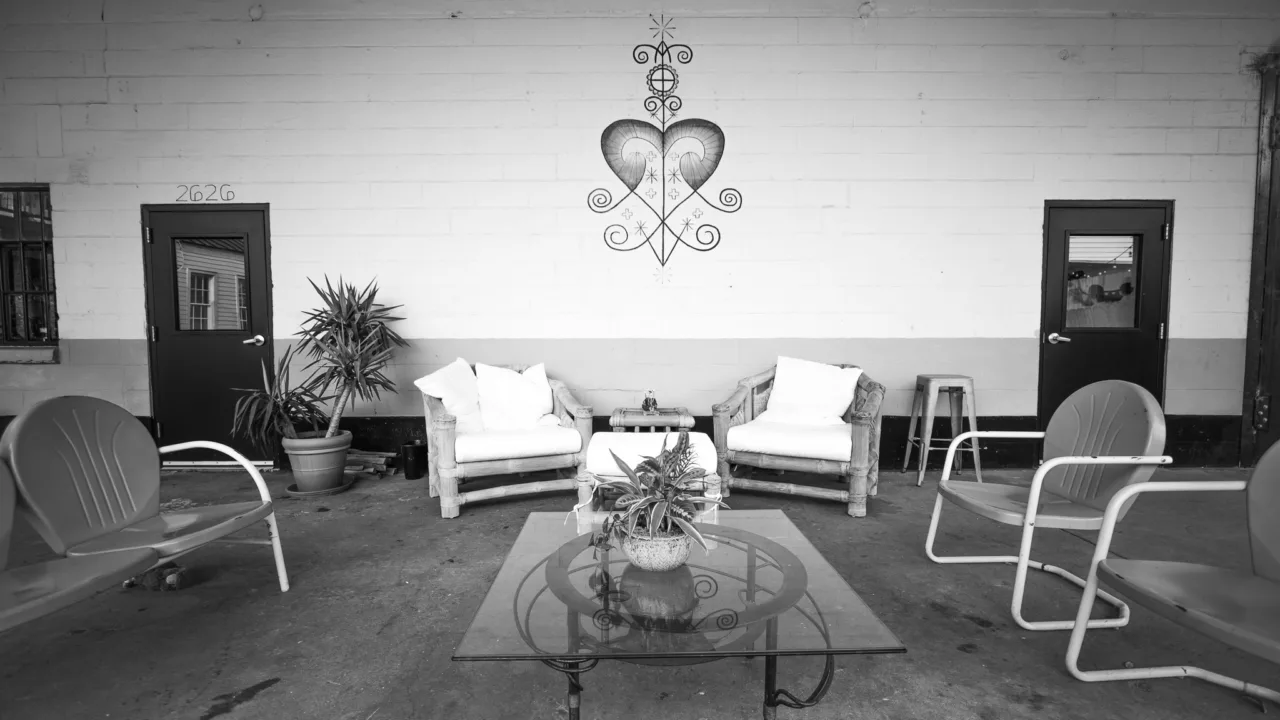
Twenty-two thousand square feet is not just a number. It is the physical infrastructure required to do work that matters without compromise. Two stages means you can build a set and run a session in the same building. A gallery means the work is visible — not locked in a hard drive, not sitting in a vault, but on the wall, in the room, part of the space. A kitchenette means people stay. They eat together. They talk. The work happens in the margins between the takes, and the building is designed to make those margins possible. The Fish Pot Sessions — the gatherings where musicians, filmmakers, and creatives converge in the warehouse space — are not events. They are the practice. The blue-lit room with the brick wall and the wooden table and the tripod in the corner is not a set. It is the studio doing what it was built to do: bringing people together and letting the work happen.Elsa Kern and the New Orleans Root
Elsa Kern, a New Orleans native, joined as a founding partner in 2017. Her role has been instrumental in shaping the studio’s vision and direction — rooting the company in the culture and creative energy of the city she calls home. That matters because a studio’s relationship to its city is not abstract. It determines which doors are open, which stories are told, and whose legacy is preserved. A studio rooted in New Orleans by people who are from New Orleans makes different decisions than one that is passing through.Productions
The catalog speaks for itself. Professor Longhair, Rugged & Funky — a 2020 documentary about one of the foundational architects of New Orleans piano. Rock and Roll Fuck’n’Lovely — a 2013 feature film. Derek Smalls. Fallout. A body of work that spans documentary, narrative film, music video, and live concert production, all filtered through the same philosophy: find the raw, chaotic, unfiltered moments that others edit out as noise. In a city that invented the backbeat, a studio that hunts for the noise instead of editing it out is not just a production house. It is an act of preservation. And in a world where the industry feeds audiences heavily processed, formulaic rations, a studio that refuses to sanitize the feast is not just a business. It is a stance.The world is starving for something real. Fish Pot Studios is one of the places still serving it.


Leave a comment